• Skip to main content
  • Skip to footer
  • HOME
  • PROGRAMS
    • Campus Peer Ministry – Young Adults
    • Peer Ministry Leadership – High School
    • ALL IN Relational Ministry – Adults
    • Everyday Samaritan – Early Teens
    • Peer Ministry Skills – Elementary Ages
    • Spirituality Connections – Youth and Adults
    • PLAN IT
    • SPEAKING
  • ABOUT
  • BLOG
  • STORE
  • CONTACT US
  • DONATE

Relational Leadership Collaborative

Leadership Training

Uncategorized

November 17, 2015 by newpeermin

OUT-HOUSE MINISTRY?

YOUTH MINISTRY is LEADERSHIP Ministry

# 6. What if—participation in soccer, choir, robotics, band, work, and football are valued as places of ministry? 

“Sometimes I am too busy to show up at church. I used to feel guilty. Now my church tells me they need me on the team.” When churches teach skills for caring, welcoming and affirming, they also learn to encourage and support youth with these skills “out there!” “Out there” is where youth actually have interactions with people and do their ministry.

pastedGraphic.png

Intentionally helping youth live life as ministry!

Okay, pause! Yes, I know what it sounds like. I apologize. Much of my education came from junior high kids! But, I couldn’t resist. If churches are building youth leaders, they are most likely using them for IN-HOUSE church programs, the ones that happen under the roof of their congregation’s building. The opposite must be… OUT-HOUSE ministry, which really means that youth are living their caring, welcoming, and affirming leadership every day, everywhere, and in every relationship.

Our normal church expectation for youth is that we need them to sign-up, show-up, go with, go to, experience, discuss, volunteer, worship, perform, fulfill, accomplish, and, of course, love a good old fashion night of laser-tag! (And I am all for all that!) BUT IF, this is the experience of “church,” then we have placed faith in a narrow silo.  UNLESS we are intentionally facilitating faith experiences in everyday life, we are not helping our youth to BE the church.

I prefer defining living daily faith as a Christian witness that is about welcoming, loving, listening, feeding sheep, being living water, giving to others, being the last so others can be first… It is about loving one’s neighbor.

I begin by telling youth, “You are all ready doing ministry! We may have forgotten to tell you!” I want to believe that everyone cares for someone.  Human nature at its best desires  something better for others. And virtually everyone is willing to listen to the great joys and the great sorrows of another.

So, how can we transform youth ministry into intentional OUT-HOUSE ministry? Here are some ideas:

1. Begin by teaching that ministry is more about listening, caring, welcoming and affirming,  than about arguing, convincing, changing, or persuading.

2. Let’s assume youth are already doing ministry. Let’s explain how their caring relationships is ministry. Than let’s equip them with further.  <CLICK> (Blog, Assuming youth are ministers.)

3. Keep asking youth about weekly “Spirit nudges,” those things they saw, heard, or sensed that concerned them. This moves discussions to an outward ministry focus. <CLICK> (Blog, learn more about Spirit Nudges.)

4. Invite youth to pray for others (Rule of thumb: no names, no prayer gossip.) Pray for concerns, those “Spirit Nudges” that need to be lifted up in prayer.

5. Keep track! Ask your youth to name the issues of concern they talked to others about this week. List the topics. Ask how many times they heard their peers express these concerns. <CLICK> (PDF example.)

6. Listen to concerns youth are talking about. When topics like suicide, depression, eating disorders, or bullying, come up, facilitate  a discussion, bring in a speaker, work on what you can say or do to help friends in these specific situations.

7. Give every “student leader” an adult mentor to meet with at least four times a year. The mentor is to ask the questions about  leadership, both “In-house” ministry questions and “Out-house,” every day ministry questions. <CLICK>. (One page guide)

8. Ask student leaders to speak about how PML skills have helped him/her help someone else. ( The church word for this is “testimony.”) Write up these stories, posting them as examples of everyday ministry.

9. Celebrate and appreciate student leaders’ everyday ministry. Host a dinner, give a certificate, take one person at a time out for coffee. affirm, uplift and highlight everyday ministry in all the ways you can.

10. STOP seeing sports, music and extra-curricular activities as the enemy! It is in these activities that your youth can connect with others. Teach them how! <CLICK> (Blog, Church verses Extra Curricular) and <CLICK> (Blog, The Youth Ministry Rant)

Peer Ministry Leadership is one of the few approaches that gives youth concrete, ways for living life as everyday ministry. I describe it as the mission trip you don’t have to sign up for! <CLICK> (Article you can use with your youth.) It is the ministry where we can tell youth, “You need to leave the church!” <CLICK> (Another article you may want to send to your youth!)

I can go on and on about the reasons every church needs Peer Ministry Leadership as a foundation. PML training is important, but don’t confuse that as accomplishing Peer Ministry.

The short summary is this: We are misleading youth as to what ministry is if we are not naming and helping them live ministry every day, everywhere and in every relationship.

(If PML is something you want to see within the next couple of years, we should start the conversation now! Send a note, ask questions, let’s put a plan together!” <EMAIL>)

Filed Under: Blog, Uncategorized

October 21, 2015 by newpeermin

Peer-In-Midst

PEER-IN-THE-MIDST
Chapter 4 in PLAN-IT 
book by Lyle Griner

Youth Ministry Lens #3

I sat in a restaurant watching my mentor and teacher draw a version of this pyramid on the back of a napkin. He was well known for a Sunday-night youth ministry program he had grown from a handful of youth into a regular gathering of 300 to 400 youth! What he explained was profound and humbling. He realized most churches are not destined to have this kind of attendance but he explained to me that the importance of youth ministry, in any size congregation, will not grow unless time and resources are concentrated on building and fostering a strong core of leaders, both adults and students. Growing a youth ministry is never about a single leader or personality. It is about a culture of caring leaders!

I ask youth ministers and pastors who work with youth this question: “How many youth can you keep up with on a weekly basis to know what they are thinking or feeling?” Depending on how the question is interpreted, most answer four to eight. It’s always a rather low number.

Reality! I have seen many churches, some quite large with full-time staff, that have small numbers attending. Why? The leader has reached his or her relational capacity.

You have two choices in your youth ministry programing:

One: Try to do it all yourself, resulting in small numbers and limited spiritual depth.

Two: Build a relational, caring, welcoming, and affirming leadership team of youth and adults, resulting in expanding numbers and greater spiritual depth.

That is blunt, but real! This works, not only for large churches, but also for small ones. Your core team may be four people; it may be 40 people. Whatever your situation, start small and begin building a team.

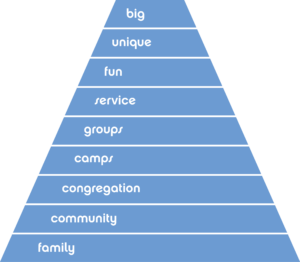
I like visuals. Note the pyramid, which has evolved from the napkin version. The layers illustrate program categories commonly used by churches for spiritually nurturing youth. What follows is an explanation of each level of the pyramid, starting from the bottom. Note that the larger the levels, the more expansive the influence on numbers of youth. Your congregation may arrange the levels differently, have different words for them, or even add other levels. The significance of the model does not change.

pyramid1

Your church may arrange the levels differently, have different words for them or even add other levels.

Pyramid Levels

1. Family: A foundational faith formation strategy equips families to share and experience faith together. Much of the research in the last decades reminds us that the faith patterns and practices set in the home are the biggest indicator for future faith involvement. It is the largest level of the pyramid because it is influential for all youth, in both good or bad ways.

2. Community: Youth watch for real models and examples of faith lived outside the walls of the church. Youth want to know, “Who really lives this?” Community is the testing ground of authenticity. This level is about helping youth experience, notice, and hear the stories of people who live faith in the world. Then, give them the opportunity to discuss what they are observing about faith lived in their community.

3. Worship and Congregation: What happens in a church is broader than a youth program. Youth often connect in the church beyond, even without youth ministry events. Involving youth throughout the life of the congregation requires strategic planning that allows youth to be involved. Here’s my cry: “Youth are leading or they are leaving!” Churches that say, “We need you!” to each and every youth are churches that have youth leading in every aspect of the congregation.

4. Camp: Having more youth involved in camp and retreat experience translates into more participation during the year. These shared experiences build and strengthen relationships that create culture and community for you and your participants. Note the words shared experience! Look for experiences where you and your core team of leaders can be in the midst and lead your group. Dropping off kids at a camp and not participating with them does little to help grow your ministry community.

5. Groups: Small groups or candle-time discussions are where the trust levels increase, anxieties decrease, and youth feel free to talk about faith and life, wrestling with questions and ideas. In these discussions, peers become models and mentors to each other. I believe this to be the sweet spot of peer-to-peer youth ministry.

6. Service: Many youth will show up for service experiences before any other program. Why? Because they can see and experience something that matters. Youth go where they are needed! The goal is not to complete a service event, but to develop an attitude and practice of caring for others. Effective service learning includes preparation and reflection.

7. Fun: Fun is always an element whenever youth gather. Fun is part of who youth are! After youth have established meaningful, purposeful relationships, periodic extra events focused just on fun are great. It is important to note that this level is not the foundation of the pyramid. Churches often err when assuming youth ministry is based on bigger-and-better fellowship events, falsely strategizing, “If they have more fun, they might come to church more often.”

8. Unique: Various special interest opportunities exist in churches, including bell choirs, basketball teams, and musicals; even a few (bless them) clown-ministry troops still exist. These are often developed and led by a passionate, talented person. The special-interest groups are not meant for every youth, but they give a sense of purpose and pride to those who do participate.

9. Big: Involvement in larger group experiences such as concerts and youth gatherings allow youth to discover that the church is bigger than their own congregation.

Core Focus

Now, focus on the relational core in the middle. This is the core team of youth and adults. I believe all church programs for every age are reliant on relationships. This is especially true of youth ministry. “Kids don’t care what you know until they know you care” has been a youth ministry slogan for many years. Caring relationships are essential.

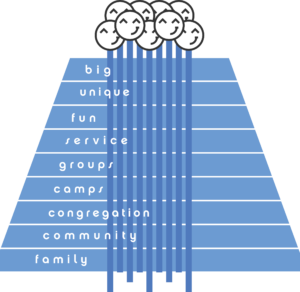
Note the first exaggerated pyramid illustration. See the problem! If a church program is led primarily by one person, the number of participants is going to be very narrow. It is not unusual to find full time youth ministers working with six to ten youth. Why? The leader has reached his or her relational capacity.

pyramid2

Now note the second exaggerated illustration. This wide pyramid illustrates what happens with a well-trained, well-equipped leadership team of youth and adults. Programs grow. Having more leaders results in the ability to maintain more caring, welcoming, and affirming relationships. Thus, the youth minister’s (or pastor’s) position is to raise up, equip, and nurture the faith and skills of a core leadership team.

pyramid3

Peer pressure is an amazing influence. A camp director once told me, “I see retreat groups come out week after week. Most have good program plans, but do you know what their participants really learn?” He paused. My attention perked. “They learn whatever the oldest youth in the group want to teach.” Youth influence the faith lives of other youth! So, stack the deck in your favor. A team of leaders who are well trained, who understand their role as caring, welcoming, and affirming leaders, creates an infectious, magnetic culture.

Adding leadership also grows spiritual depth. My personal observation is that I am a good teacher. The confirmation lessons I taught on the Lord’s Prayer were remarkable. Pure educational genius—or at least that’s how I remember them! But none of my youth prayed because of my amazing lessons. It was not until I started using high school peer ministers to lead groups at camps, at retreats, and in the midst of various programs that I heard all my youth pray aloud. Why? Spiritual practices are modeled and mentored. We learn things, like prayer, from real people who pray. As a paid pray-er, I don’t know that I am as effective as I would like to think I am. Build a team of real people, who are eager and willing to learn spiritual practices that they can participate in and share with others. Youth learn from their models.

What to Do With This Model

Share this with all of your leaders. Help each leader understand her or his role as part of the relational ministry core—especially adults, who are used to volunteering for typical roles of teaching a curriculum, providing transportation, or standing by a hallway to make sure kids don’t go down it during the middle school dance! Your adults will need help in understanding that their role is far more than volunteering or chaperoning. They need your help to recognize the influence they have as relational ministers. Sharing the visual of the pyramid is a great way to begin.

Share the model with your church leadership. Church leaders need to understand your strategy. “We need to build a team of leaders,” I told the first pastor for whom I worked. The pastor said, “That’s fine, but we hired you to be with kids. That is where I want you spending your time.” My previous experience had been with Young Life, thus my experiential reflex was to build a team of leaders. That is what I knew how to do. I did it, and the ministry grew. Seeing those results, that pastor went on to write his own doctoral thesis on Peer Ministry Leadership! He saw the results. He became a believer.

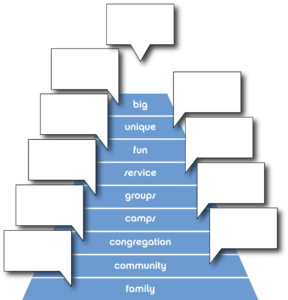
Use this pyramid as a way of evaluating your own strategies for youth ministry. Beside the levels, list the programs your church presently uses. Note which levels are your church’s primary approaches. You will be stronger in some than in others—celebrate your strengths! The goal is not to have every level be successful, but you may see levels that need a boost, or that don’t exist. How will you plan for these? Are there areas you need to spend less time on? How about that leadership  team? Are you ready to strengthen or begin that team?

pyramid chat

Filed Under: Blog, Uncategorized

September 4, 2015 by newpeermin

More Than Microphones and Committees

I met Rachel age 4 and Beth age 5 pushing small chairs in the halls of the education wing of our church. “Hey girls, what are you doing?” I asked. Beth smiled big and said, “We are playing meeting!” Their response reflected an honest view of what the church has been reduced to. 
Late night after hearing one of the top Christian youth speakers in the country I asked my group what they thought. “He was funny,” “He was good,” “I liked him,” were the replies. Yes, he was entertaining but I seriously doubt that any changes resulted.  
When youth are asked to describe Christian leadership they most often describe models represented by microphones or a committees. What kids most often see are people holding microphones speaking or singing on platforms, pulpits and stages. Kids see people sitting in committees, elected to boards, appointed to task forces, joining advocacy groups, meetings talking and planning in meetings. These are the models we see, we reward, we applaud, give money to, and train people to be.
Clarity here is important. I am not against microphones and committees. We need them, but these models only fit a few people. It seems to me that the microphone and committee leaders only exist to gather us for worship, motivation, organizing, leaning and inspiration, so that we can go into the world being servant leaders.
Aren’t the real ministry leaders the one’s who care unconditionally for their neighbor? Isn’t the real leader the least likely person who walks along side, comes close, reaches out, takes some risks, crosses boundaries, takes action and does not care about recognitions or rewards? 
“I don’t think this counts,” says the high school girl who describes hanging out with a friend on Friday night whose parents just split up. This is her response to me when asked how she was beginning to use her Peer Ministry training.
“I don’t think this counts” seems to be the response of most youth who are doing ministry everyday. We forgot to tell them that not only do such acts count, but that in fact such acts are the very essence of leadership! They are doing ministry everyday but we forgot to tell them hanging out with a friend who needs a good listener is ministry. We forgot to tell them that their acts of caring are always about God! Instead we keep exposing kids to more microphone and committee leadership styles. 

Filed Under: Blog, Uncategorized

July 24, 2015 by newpeermin

#1 Flipping Youth Ministry Assumptions

Flipping 
   Youth Ministry 
      Assumptions 
  
YOUTH-LEAD strategy #1 is really about changing our own view of youth. Let’s begin by viewing youth differently! Instead of assuming youth are a focus for education and motivation, or in need of some kind of club, let’s view them, from the beginning, as ministry leaders. 
 

Let me put it this way. Let’s assume youth are vital, critical, imperative, essential, necessary to the ministry of our church! (A single adjective just didn’t give this sentence quite the punch I wanted. Let me continue!)  Key, important, indispensable, required, and urgent to our church’s ministry. In short, every youth needs to hear the words, “We need you!” 

In reality, youth do more ministry than I do. They are in far more relationships with far more people than I can ever be. They know many more of the great joys and great sorrows than I, or any youth minster or pastor ever will. Thus, let’s flip our assumptions and assume that our youth already are our ministry partners. My personal discovery: when I begin with this assumption, youth responded by doing ministry. 
  
Begin assuming! The results will soon surprise you. 
  
“If you want active youth, give them a purpose!”
 
IDEAS FOR “ASSUMING” YOUR YOUTH INTO MINISTRY
Choose your theme this year to reflect a commitment to people-oriented ministry: WE CARE, or GOOD SAMARITAN LEADERSHIP, or LOVING, BECAUSE CHRIST FIRST LOVED US!
  1. Learn and practice the skills from Peer Ministry Leadership yourself. “Live it before you teach it!”
  2. Teach Peer Ministry Leadership! <CLICK> to ask how to begin!
  3. Help your adults become models and mentors, with the skills of Peer Ministry Leadership.
  4. When you gather for discussions, use TALK-ABOUTS. These are twelve discussions about caring, welcoming and affirming others!
  5. Ask about concerns for others. I call it “Spirit Nudges,” What did you see, hear or sense that concerned you this week?
  6. Give youth a project to do with people each week. If you know what “WHEAT” is, challenge them to WHEAT at least six people this week and share experiences next week!  (Learn about how to WHEAT from Peer Ministry Curriculum.)
  7. Read and start using some of the 24 Youth-Lead strategies <CLICK>
  8. ASK about YOUTH-LEAD coaching. “Youth are either leading or leaving.” Take seriously the development of strategies where kids are not leaving.
 
I hope you send this letter 
to all your youth! 
Dear (your youth’s name),
You’re it! I am handing off the ministry to you. I just can’t keep up.
Why do I say that? You have friends, classmates, co-workers, neighbors and even people to whom you are related.  I can’t possibly care for all these people, but you can!  You already know their joys and sorrows. The most important ministry is being among people, listening to them, caring for them, celebrating with them, and loving them because Christ first loves us. 
  
I am sorry if  we have made ministry look complicated. It really isn’t. So, this year, our emphasis is helping you to help others. When we gather, we’ll give you some tools to help you be really good at caring, welcoming and affirming people. We’ll talk about the issues with which people are struggling. We’ll pray for the people you are worried about. Basically, we are here for your ministry, the ministry you live every day, everywhere and in every relationship. 
Below is a list of what is coming up this year! (Add your upcoming events!) 
Blessings,
Your name here! 

Filed Under: Blog, Uncategorized

  • « Go to Previous Page
  • Page 1
  • Interim pages omitted …
  • Page 5
  • Page 6
  • Page 7
  • Page 8
  • Page 9
  • Interim pages omitted …
  • Page 19
  • Go to Next Page »

Footer

RELATIONAL LEADERSHIP COLLABORATIVE

Relationships is your key for a successful buisness, organization, or church.

Send a Note and Sign Up For Our E-News and Relational Skill updates

  • This field is for validation purposes and should be left unchanged.

Handcrafted with on the Genesis Framework

Facebook Instagram Call Now