by Lyle Griner © 2014
HOW TO READ THIS DOCUMENT
The following are elements that have proven themselves in multiple settings. The intention is not to be prescriptive but to give you beginning points for forming your own growing youth led youth ministry! While the examples here talk about multiple small groups you maybe starting with one group. I have learned through the years to trust the system and stick to the plan. Groups can and do grow! Consider each element and adjust it for your setting and ministry.
EXPECT RESULTS
Deepening of faith. Faith comes from those who model and mentor it. This style of youth ministry includes building more and more youth and adults who share in faith conversation, spiritual practices and the traditions of faith. These youth and adults are “real people” to other youth.
Expanding in Numbers. All ministry is relational. Youth ministry is highly relational. A single person leading the typical youth group can only keep up a handful of relationships to know what kids are thinking, feeling, and experiencing in life. This style of youth ministry places an emphases on creating more and more relational leaders, each who can relate to a handful of others.
Developing Leadership. Kids are leading or they are leaving. Finding as many ways as possible to encourage, enhance and then allow kids to lead translates into a congregation that is saying, “We need you!” This style of ministry not only builds leaders among a core team but also assumes that all participants are leading as Good Samaritan leaders.
FOUNDATIONS
Theology of Grace
All have sinned and fallen short of the glory of God; they are now justified by his grace as a gift, through the redemption that is in Christ Jesus. – Romans 3:23-24. We love because Christ first loved us. – I John 4:19. Very briefly… God’s love and grace is for all. Our response is to love others. Youth need to know that not all religion is about arguments, manipulative belief systems, and obsession over who is in and who is out. Youth need to know people of grace, places of grace, and a God of grace.
Culture
Culture is intentionally created. There are no membership expectations, no attendance requirements, no judgements, no popularity standards. Faith is honest, not a snobby faith, not a better-than-thou faith, not a showy happy-joy-joy-vibrant-shiny-faith, but one that welcomes every bit of life; the good, the bad, the great joys along with the great sorrows. It is okay to leave your mask at the door. The culture is created! It is learned from a well trained faith nurturing group of PML youth and adults who hold each other accountable, creating this culture and who become “culture keepers.”
The culture is stated in an ever present litany that names that all are welcome. A grace place is not list limited. No person is lesser than another, or ever looked down on. You have not been here for a while? We understand. Come on in. Not feeling very religious lately? It’s okay. Confused about what you believe? Even belief is not a requirement. Never been here before? We are making this a place you can feel you belong from the very first time you come. Too busy? Busyness always creates an emptiness. When you are too busy, it is time to step out of the fast traffic of life and come to just be! We know that too busy starts to equal empty. Pause, come in and fill up.
Youth Group to Youth Ministry
Changing language from “Youth Group” to“Youth Ministry” communicates a change in thinking. The word Group has the sound of a membership club, something that faces inward, a direction that becomes about maintaing and entertaining itself. Ministry, faces outward, it cares, welcomes and affirms people beyond those that gather. Ministry sees needs, welcoming, including, serves, and is always desiring to make life better for others. Youth Ministry has a purpose assuming that those gathered are also be encouraged and equipped to serve others. “You know people? Then you have a ministry that is happening every day, everywhere and in every relationship.” Ministry helps participants be ministers.
Safe Place, Safe People
Yes, background checks for adults. Yes, written behavioral polices for all leaders. Every church must have these in place. Expanding from the polices, there is a safe place and safe people culture where every person, their ideas, beliefs, and life situations are respected.
BEHIND THE SCENES
Peer Ministry Leadership Training
Think of PML as the cultural training that permeates all that you do. Ultimately I want youth who are caring, welcoming and affirming, youth who live faith every day, everywhere and in every relationship, youth who love because of Christ’s love. PML training gives youth and adults the skills. As the culture builds the skills are molded and mentored. Your culture becomes infectious. Consider offering this training at least twice a year. Offer the PML experience to whoever wants to participate. Consider using this as the prerequisite to being on the leadership team, thus going through the training does not assume commitments on leadership teams.
Leadership Team Youth Leading Small Groups
This Candle Group leadership is made up of high school youth who have Peer Ministry Leadership training, but also have applied, collected recommendations and participate in a cycle of regular training and enhancement events. There are often two leaders per group. First year leaders may be paired with a second or third year leader. These candle time leaders lead the discussion relying heavily on all their PML skills which are constantly reviewed and enhanced.
Leadership Team Adults
Using youth as leaders does not eliminate the need for relational adults. In other programs adults normally are placed in the roles of leading curriculum or being boundary keepers. In this setting adults function more as participants who model and mentor the culture. Each adult may be asked to be the support and prayer partner for two or more of your youth on leadership teams. Adults guide, help, participate and support but never take over the leadership.
Relational Leadership Care Team
We have a team of youth who listen and pray with others, helping them understand life in the midst of choices, changes and challenges.” Church staff call on individuals from this team when there are special needs sometimes referred to church leadership as pastoral care. These range from hospital visits, dealing with crises, integrating those new to a community and more. Youth may go with a pastor, be introduced by a staff member, or recognize needs in their daily interaction with peers. You will want our help in preparing this team and your church staff.
All Participants Are Good Samaritan Leaders
We assume all kids are relational Good Samaritan leaders. All youth are in relationships and are very aware of friends who struggle with changes, choices and challenges. Candle groups ask often, What are the “Spirit Nudges” experienced this week. Spirit Nudges are the things participants saw, heard, or sensed over the last week that concerned them. Groups talk and brainstorm various ways to help. Confidentiality is a must.
The Setting
Neutral ground! You will choose what works best. I have a bias. My favorite choice would be in homes. Church buildings immediately assume expectations and membership. Homes allow for impartial participation. Homes demonstrate that faith can be found outside of church buildings. Every time a new home is used, new parents witness first hand this amazing evening. Parents are your best advocates, as they share with other parents. Although I am biased about using homes, most still choose the setting of the congregational building. Think through intentional welcoming places. What space will most allow for youth to bring friends who are unfamiliar with your church.
Planning and Organizing Skills Required
No more, “Winging it.” No more, “Flying by the seat of my pants.” The leadership has to do the background work, putting systems in place for planning, tracking, including, training, nurturing, inviting, recruiting, managing time, staff relationships, envisioning, even juggling. People avoid overwhelming , but in the long run, systems help a person juggle all that needs to be done, done well and allows for growing to the next levels. These are learned and mastered one at a time. (We can help coach many of these systems!)
PROGRAM ELEMENTS
Welcome
Hospitality plus! Participant arrival time may have very little or no programing. Still, intentionally planning a welcoming atmosphere is crucial. People decide within a couple minutes if they like what they have entered into. No wants to be ignored, no one wants to become the center of attention. Leaders know to welcome, greet, introduce, making casual connections.
Options may include food! Pizza almost always works! Optional, casual, activities may include participants hands on interaction. Some use game tables, art activities, a challenge such as a minute-to-win it game.
Standup Leaders Meeting
Just before the evening begins the leadership gather in a standing circle possibly in a side room or back hall. The meeting is a quick, possibly only four minutes. It is just enough to review the plan and highlights of the evening. The leaders get some quick reminders about why they are there and share a prayer that blesses the evening. The meeting is just enough to reunite, focus and remind your leaders that they are the to leaders, and the models and mentors of the culture.
Playful Beginning
Use a game or a similar element to unite everyone in the room. People walk into a room scattered, each with his or her own thoughts and feelings. Someone just had an argument with mom, someone made it into the play, someone lost a basket ball game… got a “D” on a test, accepted into college, is worried about a boy friend, is new and is wondering what to do. The best illustration is to imagine a funnel. At the top all are far a part. People think in terms of “they”, “them” or “those other people”. The evening’s design gives people a common experience bringing them closer together where people think in terms of “us” and “our.” The beginning game or including activity begins this funneling process. The atmosphere is lively, full of laughter, smiles, always inclusive, always welcoming. The goal is to include everyone in nonthreatening ways.
Music / Worship
The funneling of energy continues with more uniting elements, often in the form of singing. Songs moving from most familiar and lively to quieter and more reverent. The leadership team is united in leading each song as they are scattered among participants. Their job is to model and help those around them focus with those leading. The up front leading includes various youth who help lead.
Participant Greeting
Early in the evening one youth, a different person each time, gets thirty seconds to say three things. 1.– Verbally expresses a sincere welcome. 2.– Highlights a statement about the culture. E.g. “We believe all are welcome, we have no membership lists or requirements.” Or “We hope this is a place where you can be yourself, you can leave you masks at the door. You will be accepted for who you are.” These statements are chosen from a list of cultural statement created by your leadership team. 3. The speaker shares a personal reason for coming.
Motivating the Topic
A combination of student and adult led motivators introduces the topic and biblical narrative. Methods of story telling using drama, personal stories, demonstrations or other creative methods invites participant’s to want to talk. This is not a lecture nor a teaching class. The opening message is almost always concluded with a version of, “As you go into groups tonight I hope you talk about…”
Candle Groups
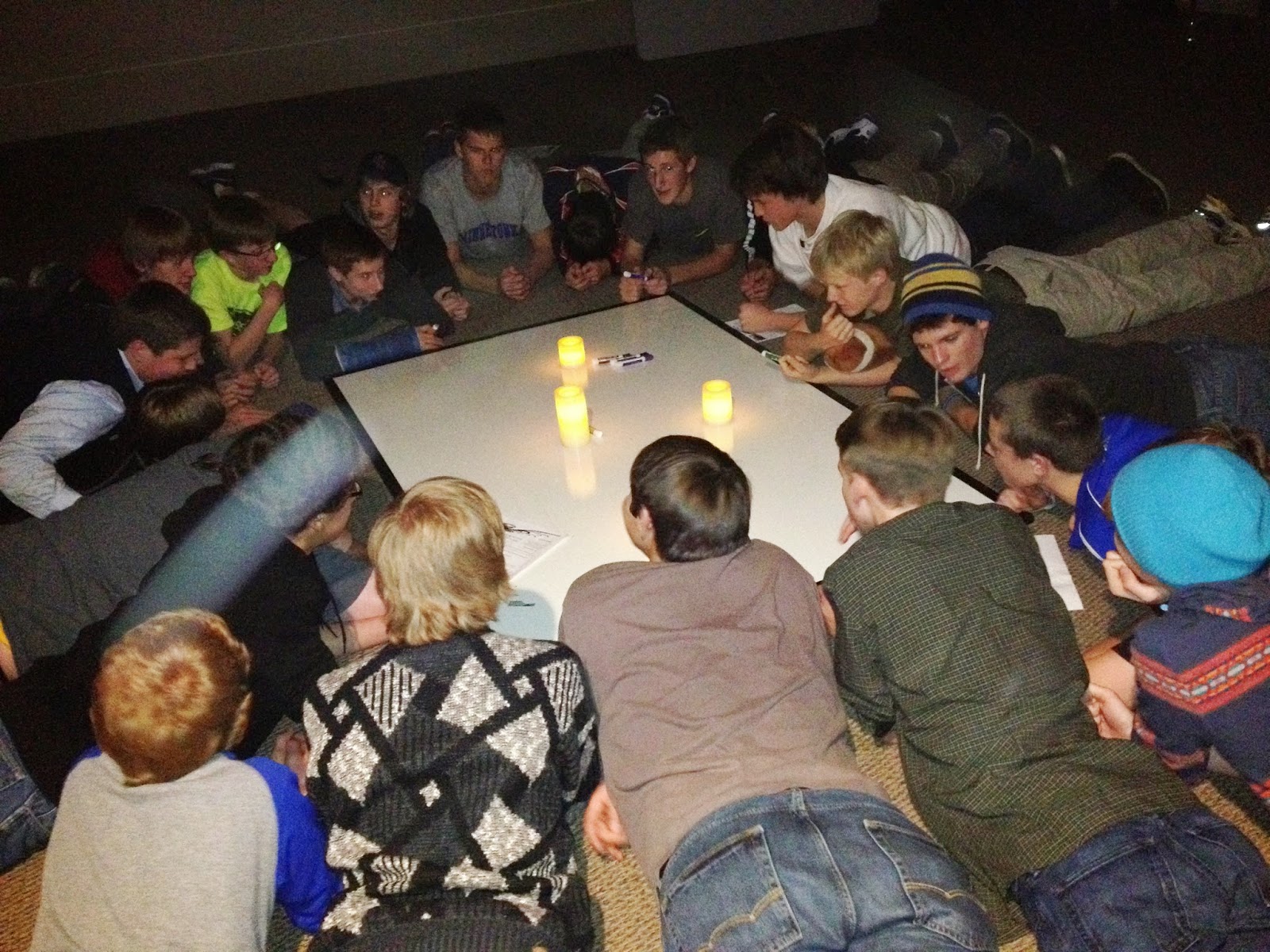
Small groups are called Candle Groups. Picture youth sitting in dimmed spaces with a candle (battery candles save on wax spills) recreating the atmosphere of the campfire, talking deeply about faith and life. The groups consist of two high school leaders and about six other participants. (If groups get bigger than this some members will stop participating.) There is also one adult in each group modeling participation and also helping coaching and supporting the candle group leaders.
Each group uses a candle, but may also have a supply box that can double as an altar, or a cloth where highlights, group norms and quotes can be written.
Candle Group Curriculum
Plan a year at a time. You may have a curriculum you like and can draw from. Most group leaders find they like to write their own. Mostly the group leaders need a good variety of open-ended questions that allow for the flow of ideas and personal story. Use a variety of topics and styles for small group interactions. Head –
biblical story and theological thinking. Heart – Relational connections and skills. Hand- Responses to faith, doing ministry, and Holiness – faith practices.
Naming Candle Group “Ah-has!”
People only learn what they reflect back on! There are a variety of methods to do this, format, every time you meet. Ask, “What are you leaving with?” Ask the group to name a highlight and write it on their box or alter cloth. Invite one participant as you begin to listen and summarize at the end. Ask the leaders of each group to name one highlight they heard in their group when groups return for candle time.
Last Words
The leader, likely the youth minister, gets the last word. A summarizing statement. An invitation or challenge, “I hope that one of the things you consider is…” Or… “One of my personal surprises from this scripture is that…”
Candle Time Prayer
This is a time to turn all awareness towards God. At the end of the evening, candles are brought together from the groups and everyone surrounds them in the dark for prayer. Prayer is shared in different ways and in different formats. It may include song, and a simple style of worship. Prayers may be in pairs, small groups and sometimes in the midst of a large group.
NEXT STEPS
- A guided experience of all the elements
- Candle Group skills experience
- Invitational skills with evening experience (including supportive parents.)
Contact us at
Web Site